 mTriage
My first startup took 1st place at TeenCrunch.
Software for paramedics at mass-casualty incidents: record patients quickly, coordinate teams and hand over clean documentation. It started as AI triage for hospital emergency departments.
Overview
mTriage was my first startup, and the Econverse Cup in Poznań in October 2024 was my first business and startup event. There I met Mikołaj Mikołajczak, who, surprisingly, turned out to be from my own town, Jarocin. He came up with the idea of AI triage for emergency departments, and we started building it together.
We reached the Econverse final in December 2024 but did not win. We wanted to keep going, and over the following months the idea changed from AI triage in hospitals into working software for paramedics at mass-casualty incidents, which won TeenCrunch in June 2025.
Problem and users
The first version targeted hospital emergency departments, where patients can wait a long time before anyone assesses how urgent their case is. We wanted patients to answer a short questionnaire on a tablet and have AI suggest a triage priority.
After the pivot, the users were paramedic teams. At a mass-casualty incident, such as a serious road or tram accident, they record each patient on long paper forms, by hand and often wearing gloves. The result is slow to fill in, hard to read and hard to pass on to the next team or the hospital.
The pivot
We met the head of Jarocin County, and then organized a meeting with the staff of the county hospital's emergency department. Together with a paramedic who joined as our advisor, that pointed us to a sharper problem: documentation and coordination when many patients need help at once.
How it went
My first startup event
At the Econverse Cup in Poznań I met Mikołaj Mikołajczak, who turned out to be from my town, Jarocin. We started mTriage there and reached the final in December 2024.
Meetings with the Jarocin County head and the county hospital's emergency department
The first conversations with the people who run emergency care in our county.
Meeting with the Jarocin County head and staff of the county hospital's emergency department, which led to the pivot. Econverse Cup final
We reached the final but did not win.
Econverse final, December 2024: the first version, a symptom questionnaire for emergency departments. mTriage pivots to mass-casualty incidents
As we joined the TeenCrunch accelerator, and after meeting the Jarocin County head and the county hospital's emergency department, we moved from AI triage in hospitals to software for paramedics at mass-casualty incidents.
Warsaw Startup Club: presenting the mass-casualty version. First place at TeenCrunch
At the Demo Day closing the TeenCrunch accelerator, the jury gave mTriage first place. Rzeczpospolita covered the results.
TeenCrunch Demo Day, June 2025, with Mikołaj Mikołajczak.First place at TeenCrunch, 13 June 2025. Freezing mTriage
A month after winning TeenCrunch, we froze mTriage and later archived it. My time went to Codaro.
My role and collaborators
I co-founded mTriage and built the software. Mikołaj came up with the original idea. Dominik Stojczyk, a paramedic, advised us and tested the app.
The awards, meetings and pitches were team results.
- Built the software: the Python prototype, then the Next.js app with live updates
- Pitched it at the Econverse final, Warsaw Startup Club and the TeenCrunch Demo Day
- Took part in the meetings with the county and the hospital that led to the pivot
What we built
The first version, shown at the Econverse final, ran on a tablet in the waiting room. The patient described the problem in their own words, AI generated follow-up questions with tap-to-answer options, and the triage nurse received a summary with a suggested triage category to approve.
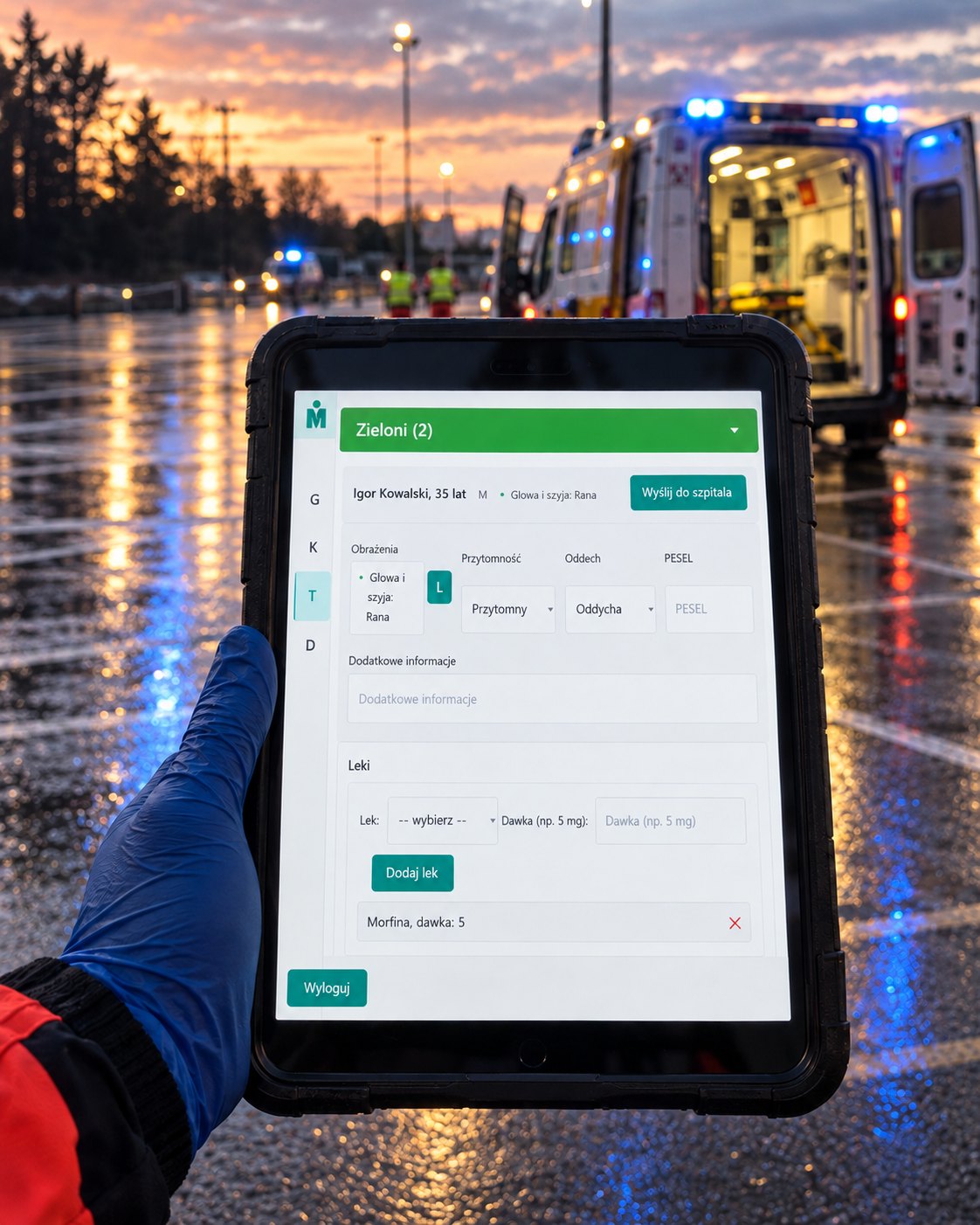
A web app for paramedic teams. Each patient is recorded in a few steps (injuries, consciousness, breathing, medication and dose), and patients are grouped by triage colour. The team leader sees the status of every team and can send a patient to a chosen hospital.
Instead of a handwritten card, the app produces a clean, printable dispatch card that follows the structure of the standard paper form.
Next.js, Supabase, WebSockets, Python and the OpenAI API (first version)
Engineering decisions
The first prototype, the emergency-department questionnaire, was written in Python. For the mass-casualty version I rebuilt the app in Next.js with a Supabase database.
At a mass-casualty incident several teams record patients at the same time, and the team leader decides where each one goes. Updates therefore travel over WebSockets: a patient added by one team appears on the leader's screen straight away, without anyone refreshing.
The app shows its live connection status and latency, because teams in the field cannot assume a stable signal.
Product and business decisions
We planned to license the software per hospital: a free tier with limited features, an annual licence and a one-time licence, each including tablet integration, support and training for paramedics.
Hospitals and counties buy through public digitalisation programmes, so we mapped which funding programmes could pay for it. We also considered selling through established hospital-software vendors instead of only directly.
Outcomes and evidence
First place (5,000 PLN) at the TeenCrunch Demo Day on 13 June 2025, chosen by the jury from the accelerator's teams. mTriage also received media support from Rzeczpospolita, which covered the results.
Working software, tested with paramedic teams. Our paramedic advisor presented it at one of the largest training events for paramedics in Poland.
A paramedic who tested it said: “This is literally what I wanted to have.”
Lessons and next steps
The most useful step was letting go of the first idea. Meeting the people who run emergency care in our county showed us a problem they actually wanted solved.
In July 2025 we froze mTriage, and later archived it, because I was focusing on Codaro. The next steps we had planned were registering a company, certifying the app as a Class I medical device under the EU MDR, field tests, and integration with ambulance teams' tablets.
Pitch decks
The cover is public. The full deck is available with an access code.

mTriage: smart triage in the ED
Presented at the Econverse final, December 2024. Before the pivot. In English.
Access code required: View deck

mTriage: an app for paramedics
Presented at the TeenCrunch Demo Day, June 2025, where it won first place. After the pivot. In Polish.
Access code required: View deck
In the press
- Młodzi innowatorzy i liderzy biznesu nagrodzeni w ramach FutureCrunch
TeenCrunch results: first place for mTriage, named with me as author, and a place at Google for Startups for Codaro.