 Codaro
Google for Startups residency. Three markets tested, the third one paid.
Developer-insights software that turns live coding activity into a clear, real-time picture of what a software team is doing, without status meetings or micromanagement. My largest project, and the first I built from the start that reached paying users.
Overview
Codaro is my largest project and the one I developed the most. I worked on it for more than a year, from March 2025 to May 2026. Radosław Soysal and I started it on the night train back from the Econverse V4 final, and in practice it was mostly Radek's and my project. It became my first registered company, a Polish sp. z o.o., which still operates.
In that time Codaro won two awards at TeenCrunch, spent eight months at Google for Startups Campus, organised a hackathon for about 90 people, changed direction twice, and made its first sale. It was the first product I built from the very beginning that reached real traction.
Problem and users
We started from a problem we had ourselves as freelance developers. Developers are often paid by the hour, and the person paying has no live view of what is actually being done. Reported hours and real work drift apart, some developers inflate their time, and neither side fully trusts the other.
After the first pivot, the users became engineering leads. As teams grow and AI coding tools multiply the volume of code, managers lose sight of progress, spend hours in status meetings, and discover blockers and bottlenecks too late.
Pivot 1: from freelancers to teams
We concluded that almost nobody would pay to verify hours, and those who would, would pay very little. The bigger problem was the flood of code: teams produce more of it than ever, and leads cannot see where work is stuck.
Pivot 2: a B2C test
A smaller change that reused what we had already built, to test whether individual developers would pay faster than companies. We ran it for about three months in early 2026, and it worked: the B2C version brought our first sale on 16 March 2026.
Pivot 3: back to B2B, by the team
How it went
Codaro starts on a night train
Travelling back to Warsaw from the lost Econverse V4 final in Łódź, Radosław Soysal and I decided to start Codaro together.
Into the TeenCrunch accelerator; Kacper Kamiński joins
After pitching the first deck at several events.
Two projects, one Demo Day
I worked on two projects in the TeenCrunch accelerator at the same time. At the Demo Day, mTriage won first place, and Codaro won the Audience Award and a place at Google for Startups.
TeenCrunch Demo Day, 13 June 2025: the Audience Award for Codaro.FutureCrunch 2025, after the awards. Google for Startups Campus residency
Codaro moved into Google for Startups Campus in Warsaw, the place it won at TeenCrunch. Coworking, training and a cohort of other founders until February 2026.
Residency life.Codaro's card on the Campus founders wall. Codaro's first pivot: from freelancers to teams
Few would pay to verify a developer's hours. We moved from time tracking to a live view of progress and blockers for whole teams.
Pitching the team version of Codaro. Codaro's second pivot: testing B2C
For about three months in early 2026 we offered the same plugin directly to individual developers, to see if they would pay faster than companies. It brought our first sale in March 2026.
Hackathon Codaro
A hackathon at Google for Startups Campus in Warsaw: 16 teams, about 90 participants and over 25,000 PLN in prizes, organised by the Codaro team in one month.
Codaro Coding Challenge, 24 February 2026: the panel on the future of senior developers, seen from the production desk.Organising the hackathon. Codaro's first paying user
The B2C version of Codaro made its first sale: the first traction for a product I had built from the very beginning.
Stepping back from Codaro
After more than a year, I stepped back from Codaro to focus on OpenRoad. I stay on as an advisor, and Radek continues as CEO.
The team pivots to a control layer for AI coding agents
After I stepped back.
Second Codaro hackathon
Organised by the team.
My role and collaborators
I was co-founder and CTO, and Radek was CEO. We agreed on that split because I did not want to carry the whole company at the time, but in practice my role reached well beyond engineering. I managed the developers, Radek and Dominik Dyga, wrote a large part of the code myself, made and presented most of our pitch decks, and created marketing content, including short videos. In the summer of 2025 I regularly spent 15-hour days coding.
The co-founders were Radek, Dominik and me. The starting team also included Wiktor Dźwigałowski, whom I met with Radek at Econverse V4, and Jan Matecki, Wiktor's friend. Dominik is Radek's friend. Kacper Kamiński joined during the TeenCrunch accelerator, where I was the only participant working on two projects at once. Awards, the residency and the hackathon were team results.
- Led engineering and managed the development team, while writing a large share of the code myself
- Shaped product and company direction together with Radek, our CEO
- Created and presented most of our pitch decks, for competitions, juries and investors
- Marketing: short-form video and social content
- Co-organised the February 2026 hackathon
What we built
IDE plugins for VS Code and IntelliJ that capture real coding activity without interrupting the developer, and real-time connectors that stream that activity to the backend and on to a live dashboard.
AI pipelines that analyse code changes as they happen: plain-language summaries of what was done, review signals on the code itself, and early warnings about blockers, risky changes and bottlenecks.
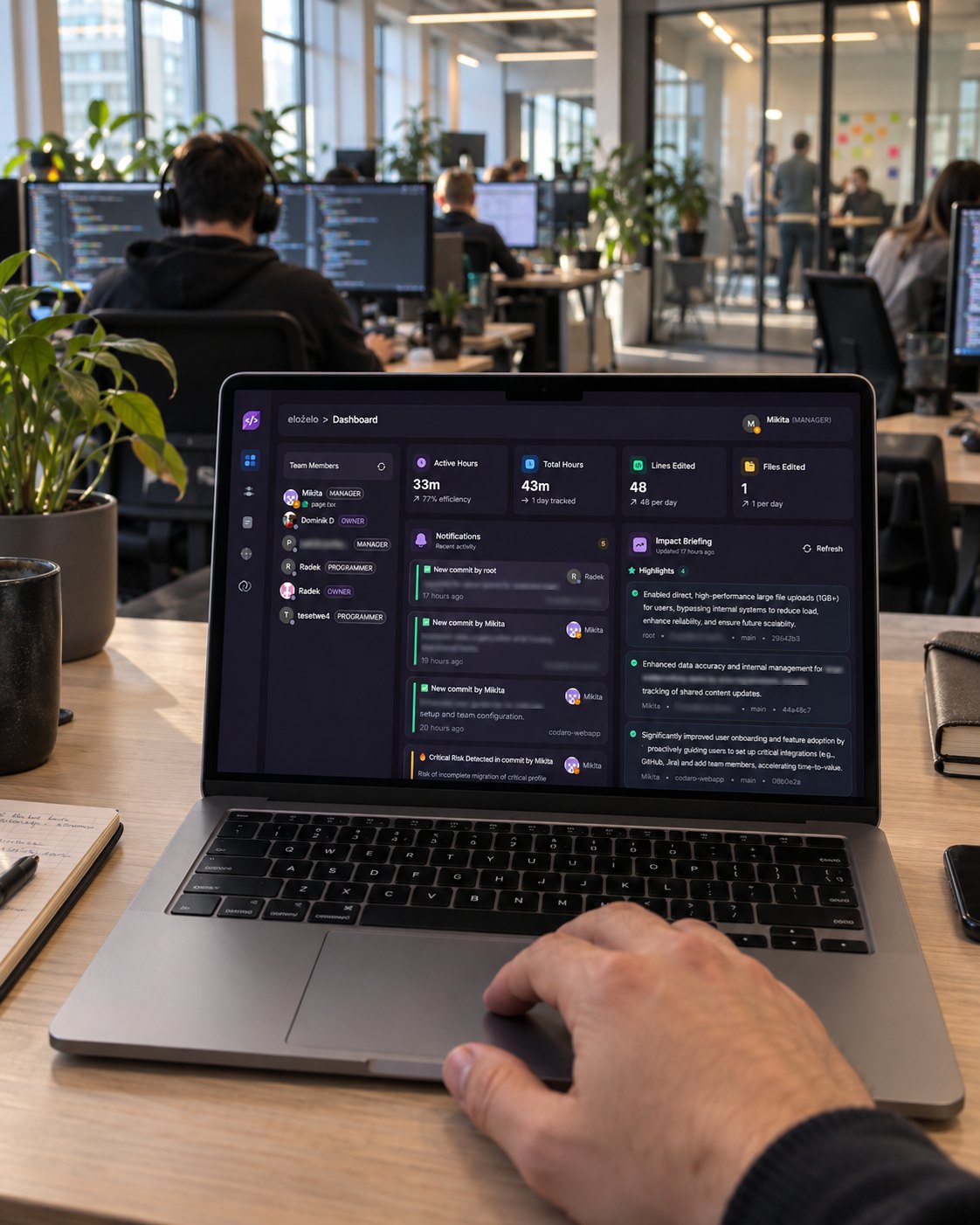
A web dashboard for team leads with a live feed, team statistics and alerts, and later a B2C version of the plugin for individual developers that reviews their code and points out bottlenecks.
Next.js, TypeScript, Google Cloud Platform, VS Code and IntelliJ plugins, Real-time streaming connectors, AI code-analysis pipelines, LLM summaries, MCP server
Engineering decisions
The core decision was to measure from the editor rather than the task board. Tickets show what someone said they did; editor activity and commits show what actually happened. The hard part was making that useful without turning it into surveillance, so the product summarises work for the developer's benefit as well, instead of streaming raw activity to a manager.
Everything ran on Google Cloud Platform. Because the product sees source code, trust was a technical requirement, not a marketing line: data stayed in the EU, customer code was never used to train models, and data was encrypted in transit and at rest. An MCP server let teams connect their own tools, and the plugins plus Git and Jira integrations could be set up in a few minutes.
Product and business decisions
We made a first deck, pitched it at several events and applied to the TeenCrunch accelerator. Pitches and conversations with managers and developers kept ending in the same place, which led to the first pivot in September 2025. After it we pitched to many investors.
The business model was a per-seat subscription with a free trial, aimed at software agencies, startups and larger teams. When B2B sales were slow, we tested the same product on individual developers instead, promoted it, and made our first sale.
Outcomes and evidence
TeenCrunch Demo Day, 13 June 2025: the Audience Award and, as Rzeczpospolita reported, a place at Google for Startups. The same day mTriage, my other project in the accelerator, won first place.
Residents at Google for Startups Campus in Warsaw from June 2025 to February 2026, alongside a cohort of startups selected for the programme: a coworking space, training, team retreats and many conversations with other founders.
Hackathon Codaro, 24 February 2026, at the Campus: 16 teams, about 90 participants and over 25,000 PLN in prizes. We had exactly one month to arrange the agenda, guests, participants, funding, venue, sponsors, partners and marketing. As far as I know, we were the only startup from the programme to organise its own event there. The team organised a second hackathon in July 2026.
First paying user on 16 March 2026, from the B2C version: real traction for a product I had built from the very beginning.
Lessons and next steps
Talking to the people who would pay mattered more than how well we built. Two pivots in a year felt slow at the time, but each came from hearing the same objection again and again, and the second one is what finally produced a sale.
From January 2026 I was also building OpenRoad's Android app, and in May I stepped back from Codaro, for my own reasons, to focus on it. I am still an advisor to the team and good friends with all the founders. Radek continues as CEO with Kacper and Jan, and has since taken Codaro in a new direction.
Pitch decks
The cover is public. The full deck is available with an access code.

Codaro: monitor, understand and guide your developers
The first deck, used for the early pitches before the pivot. Hour verification for freelance developers. In Polish.
Access code required: View deck

Codaro.dev: live GPS for dev teams
The investor deck after the September 2025 pivot to engineering teams. In English.
Access code required: View deck

Codaro: engineering intelligence platform
The latest deck I worked on, positioning Codaro for teams using AI coding tools. In English.
Access code required: View deck
In the press
- Co jeśli sztuczna inteligencja się pomyli? Polski startup znalazł sposób na kontrolę nad AI
A feature on Codaro's current direction as a control layer for AI coding agents, published after I stepped back.
- 3 godziny kodowania, pizza i 25 tys. PLN w puli. Rusza Codaro Coding Challenge w Google Campus
Coverage of the Codaro Coding Challenge ahead of the event.
- Pierwszy w Polsce hackathon symulujący realia pracy w nowoczesnym startupie startuje w Google for Startups Campus
Announcement of the Codaro Coding Challenge, the hackathon our team organised.