Legal Evidence AI
No citation, no claim: every fact traces back to the record.
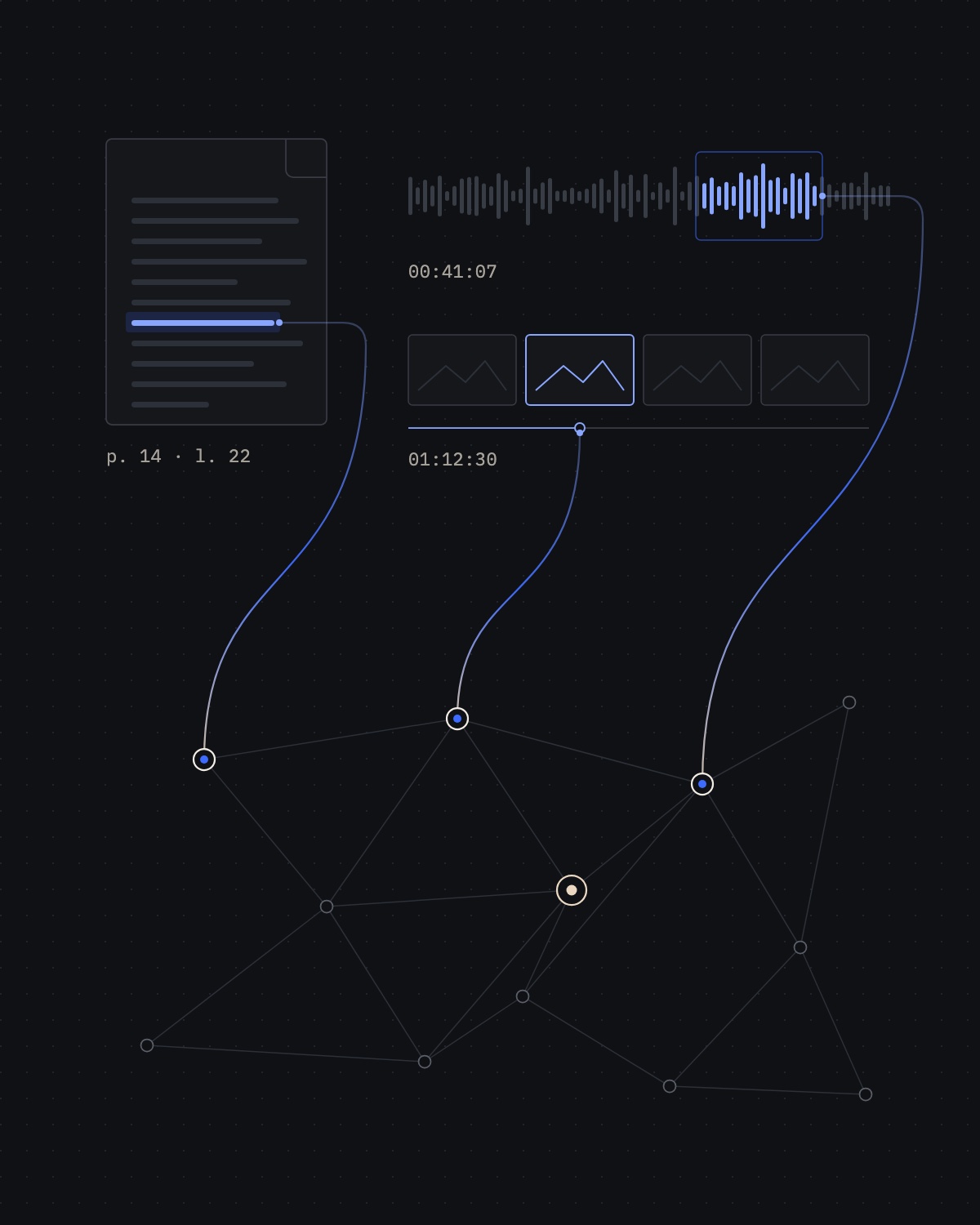
A legal-tech startup building an evidence knowledge base for trial teams. It reads a whole case record, documents, audio and video, and answers questions with facts that each cite the exact page, line or timestamp they came from.
Overview
A US legal-tech startup is building a knowledge base for litigation teams. A lawyer uploads a whole case record, from depositions and scanned exhibits to emails, phone exports and bodycam video, and asks questions in plain language. Every answer comes back as short facts, each pointing to the page, line or timestamp it came from.
I joined as lead engineer in August 2026 and built most of the system in its first two months: the ingestion pipeline, the ontology and knowledge graph, and the question-answering layer.
Problem and users
Case records are large and messy: thousands of documents in dozens of formats, plus hours of audio and video. A lawyer can only use a fact they can defend, so every claim needs its exact source.
General-purpose AI assistants fail here. Their search gets weaker as the record grows, they answer in long paragraphs that are hard to check, they miss context that sits in another file, and they fill gaps with plausible guesses.
What we built
A processing pipeline turns every file, from typed documents and scans to audio and video, into searchable evidence that keeps the exact page, line or timestamp of everything it finds.
On top sits a knowledge graph with its own ontology: sources, entities, facts, events, issues and the relations between them. The machine proposes the connections, and a lawyer confirms them.
Lawyers can search instantly or ask questions in plain language. For a question, the system plans its own search, reads the documents and checks its answer before showing it.
Google Cloud, Python, TypeScript, Knowledge graphs, Ontologies, LLMs
Engineering decisions
The ontology, the hardest part. It is a model of a legal case that a machine can fill in and a lawyer can trust. It has to describe every kind of source, from a deposition to a bodycam video, follow one person across many spellings of a name, keep facts, events and issues apart while recording how they relate, and remember who decided each value: a rule, a model or a lawyer. And it has to keep growing without breaking what is already in the graph.
No made-up facts. Language models paraphrase quotes and can attach a real quote to the wrong claim. Every quote and every sentence is verified against the source before a lawyer sees it.
Flat cost as cases grow. It is designed for cases of hundreds of gigabytes, with cost tied to what a question needs rather than to the size of the record.
Many classes of AI models working together: document layout parsing, OCR, embeddings and reranking for search, named-entity recognition, speech recognition and speaker separation, audio and video understanding, and language models from small and fast to frontier reasoning models.
Privileged data. Each client's data is isolated, and document content is never written to logs.
Product and business decisions
Three rules shaped the product: no citation, no claim; facts, not prose; and the AI proposes while the lawyer decides. When the record does not answer a question, the system says so instead of guessing.
Answers can be saved as live chronologies and dossiers and exported to Word.
Outcomes and evidence
In about two months the platform went from the first line of code to processing real case records with documents, audio and video.